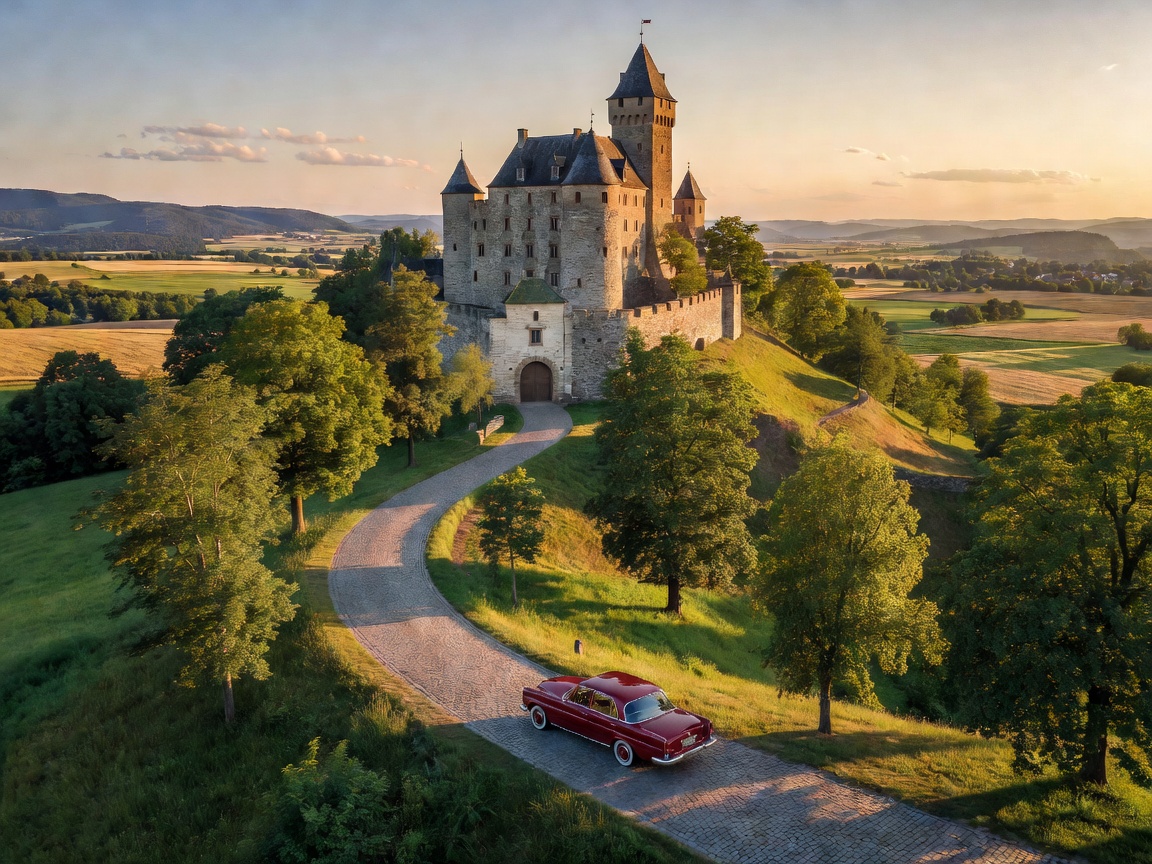
Route Overview & Cultural Heritage
Established in 1950 to revive tourism in postwar West Germany, the Romantic Road (Romantische Straße) is Germany's most celebrated thematic scenic route. Running south across Franconia, Swabia, and Upper Bavaria, the 460-kilometer route connects the baroque wine capital of Würzburg with Füssen near the Austrian border.
Characterized by sweeping regional country highways (Bundesstraßen B25 and B17), pastoral river valleys, and cobblestone town centers, the route offers grand tourers an effortless blend of relaxed GT driving and world-class architectural landmarks.
Driver Tip: Autobahn vs. Scenic Country Roads
Avoid parallel sections of the A7 Autobahn. The true essence of the Romantic Road lies along the signposted B-roads (marked with brown and white Romantische Straße icons) winding through the Tauber, Wörnitz, and Lech valleys.
Signature Waypoints & Historic Stops
1. Würzburg: Baroque Gateway & Franconian Wine
The northern terminus begins at the Würzburg Residence (UNESCO World Heritage Site with Tiepolo’s monumental ceiling fresco) and the Marienberg Fortress overlooking the Main River.
2. Rothenburg ob der Tauber: Medieval Time Capsule
Perhaps the best-preserved medieval walled town in Europe. Drivers can cruise past the historic Plönlein fork, walk the 2.5-kilometer intact perimeter defensive walls, and tour the Gothic St. Jakob's Church.
3. Dinkelsbühl & Nördlingen: The Meteor Crater
Dinkelsbühl features over 800 preserved timber-framed houses, while Nördlingen is built directly inside the Nördlinger Ries—a giant meteorite impact crater formed 15 million years ago.
4. Füssen & Neuschwanstein Castle
The dramatic finale reaches the foothills of the Allgäu Alps. King Ludwig II’s iconic 19th-century Romanesque Revival Neuschwanstein Castle and Hohenschwangau Castle rise majestically above the Alpsee lake.
Driving Dynamics & Road Rules in Germany
Unlike alpine passes that demand intense brake cooling cycles, the Romantic Road is a smooth, high-rhythm grand tour. Speed limits are strictly 100 km/h on rural open roads and 50 km/h within village boundaries. German roads have no general toll fees for private passenger vehicles under 3.5 tons.